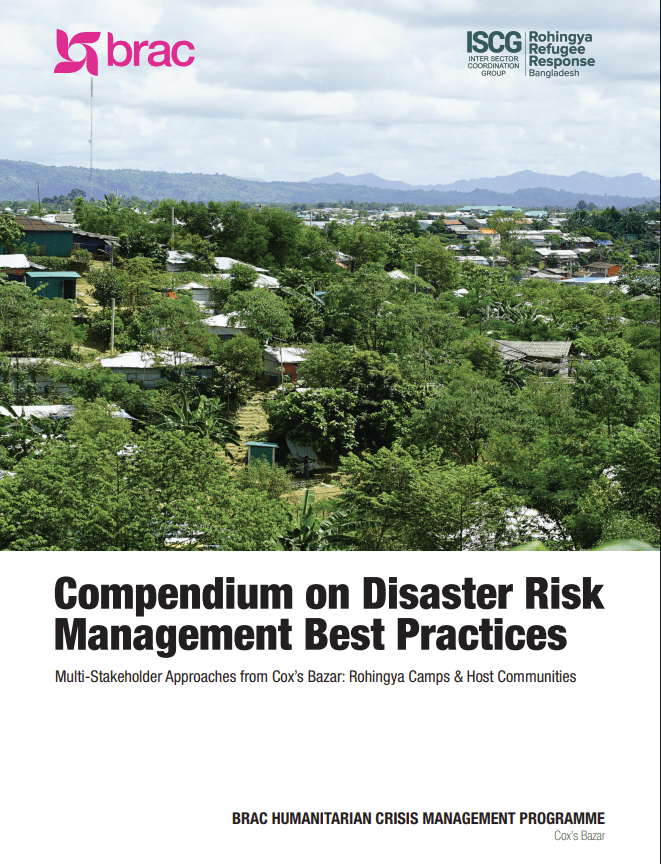
his comprehensive compendium documents evidence-driven, context-specific Disaster Risk Management (DRM) best practices implemented across the Rohingya refugee camps and adjacent host communities in Cox’s Bazar, Bangladesh. Operating in one of the world’s most disaster-prone regions, this document serves as a strategic knowledge product to improve future planning, inter-agency coordination, and localized capacity development.
GRMCS’s Contribution (Concept and Contributors Team)
As a key technical partner, the GRM Consulting Services Ltd. team—led by Dr. Md. Mostafizur Rahman, Md. Abdul Hamid, Mohammad Mizanur Rahman, Md. Musfikur Rahman, and H.M. Masudur Rahman—played a crucial role as part of the Concept and Contributors Team. GRMCS was instrumental in data collection, thematic analysis, and the documentation of field-level realities throughout the development of this compendium.
Key Thematic Areas Covered
The compendium systematically synthesizes 22 best practices across six critical DRM pillars:
Early Warning Systems, Anticipatory Action, and Risk Communication: Expanding national cyclone warning structures and volunteer-led multi-hazard preparedness.
Evacuation and Safe Shelter Planning: Documenting resilient shelter designs like mud-tally models.
Site Risk Mitigation through Nature-Based Solutions (NbS): Eco-DRR approaches, slope stabilization, and community-led watershed management.
Capacity Strengthening and Community Awareness: Organizing localized fire-drills, safety training for first responders, and integrating environmental awareness with DRM.
Inclusive DRM: Tailoring interventions for vulnerable groups, including persons with disabilities and reproductive health continuity during crises.
Coordination Models: Improving multi-sectoral mechanisms like Joint Needs Assessments (JNA) and health emergency preparedness.
Significance
By compiling actionable methodologies, lessons learned, and scalable models, this publication provides a vital roadmap for policymakers, UN agencies, and humanitarian practitioners aiming to build climate and disaster resilience in displacement-affected settings globally.