Authors:
Dr. Md. Mostafizur Rahman, Team Lead, Climate Change and WASH Expert
Md. Abdul Hamid, Co-team Leader
Dr. Abu Jamil Faisel, Public Health Expert
Syed Tanim Ahmed, Principal Coordinator
Md. Musfikur Rahman, Livelihoods Expert
In collaboration with: Plan International, Australia, GRM
Publication date: April, 2026
Executive Summary:
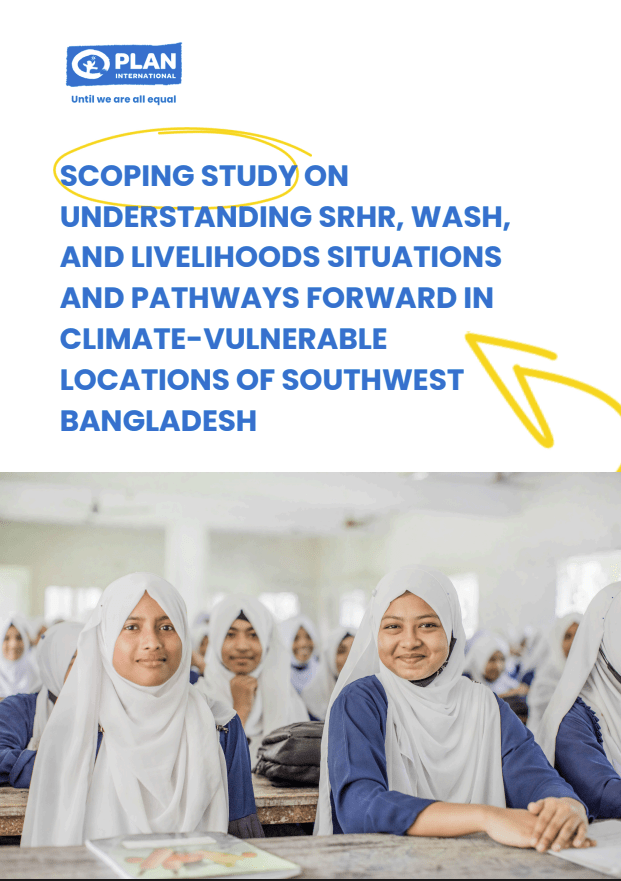
Bangladesh’s southwest coastal districts of Khulna and Satkhira are experiencing intensifying, overlapping climate shocks driven by cyclones, floods, riverbank erosion, and salinity intrusion. This scoping study examines how these climate stressors are reshaping Sexual and Reproductive Health and Rights (SRHR), Water, Sanitation and Hygiene (WASH), livelihoods, and gender-based vulnerabilities, with a particular focus on adolescents, young people, women, and marginalized groups. The study draws on a mixed-methods approach, including a household survey of 1,260 household respondents across four highly climate vulnerable upazilas, complemented by FGDs, KIIs, and IDIs to capture lived experiences and systemic gaps.
The findings reveal that climate shocks are no longer episodic but chronic and cumulative. More than 97% of households have experienced climate hazards multiple times in the past five years, with cyclones and floods dominating the risk landscape. These recurrent shocks disrupt essential services, undermine livelihoods, and generate layered vulnerabilities. Healthcare access breaks down during and after climate events, disproportionately affecting children, elderly persons, women, girls, and persons with disabilities. Feelings of insecurity are near-universal during displacement, while incidents of discrimination, harassment, and violence increase in crisis settings, reflecting weak protection systems.
Climate change is severely constraining SRHR outcomes, particularly for adolescent girls and young women. During disasters, access to SRHR services collapses almost entirely, driven by damaged facilities, transport disruptions, economic barriers, and information gaps. Menstrual hygiene management becomes unsafe, family planning services are largely inaccessible, and untreated reproductive health conditions rise, especially in high-salinity areas. Climate stress also has a strong mental health dimension, with high levels of anxiety, depression, and fear of displacement undermining young people’s agency and decision-making. Livelihood disruptions further compound SRHR risks, contributing to increased pressure for child, early, and forced marriage, especially following income loss and displacement.
The WASH situation is equally fragile. Communities depend on multiple, climate sensitive water sources, reflecting coping rather than resilience. Women face acute water shortages during disasters, unsafe sanitation conditions, and heightened exposure to harassment due to poor facility design and distance. Salinity intrusion and flooding significantly degrade water quality, increase waterborne diseases, and raise household water costs. While private sector actors play a visible role in potable water provision, their services are uneven, often unaffordable, and rarely climate resilient, leaving low-income households to absorb rising costs during crises.
Livelihoods across the study areas are under sustained pressure from salinity, flooding, and cyclones, with women and youth experiencing the highest disruption. Income loss, increased production costs, and forced livelihood shifts are common. While there is strong interest among youthespecially young women – in digital and green skills, participation remains constrained by cost, limited access to training, social norms, and weak market linkages. Private sector partnerships are seen as critical for scaling climate-resilient livelihoods, but current engagement remains limited in finance, technology transfer, and structured market access.
Overall, the study highlights that sector specific interventions are insufficient in isolation. Climate change is producing interlinked SRHR, WASH, livelihood, and protection crises that require integrated, gender-responsive, and youth-centered responses. Communities consistently emphasize the need for climate-resilient infrastructure, mobile and decentralized services, strengthened local systems, and meaningful participation of women and young people. The findings provide a strong empirical basis for designing forward-looking, integrated climate-resilient programmes that move beyond emergency response toward sustained resilience and rights-based development in Bangladesh’s coastal regions.